
Vietnamese Swimming Lacks Split Data — and the Market Is Paying for That Gap
Lane 4 touched the wall. The scoreboard jumped to 4:42.18. The stands...
Lane 4 touched the wall. The scoreboard jumped to 4:42.18. The stands applauded, the coach pressed his stopwatch, the referee wrote it into the record sheet. The women's 400-metre individual medley final was over in four seconds. In the entire meet file, that event left behind exactly one line of time.
No 50-metre split data. No reaction time off the blocks. No 15-metre breakout mark. No stroke rate, no distance per stroke, no average speed over the final 100 metres. One athlete swam four strokes and changed direction seven times, and we kept only the end result of that entire chain.
I sat in the sixth row, recording what the scoreboard does not show. Numbers never lie, but they know how to hide.
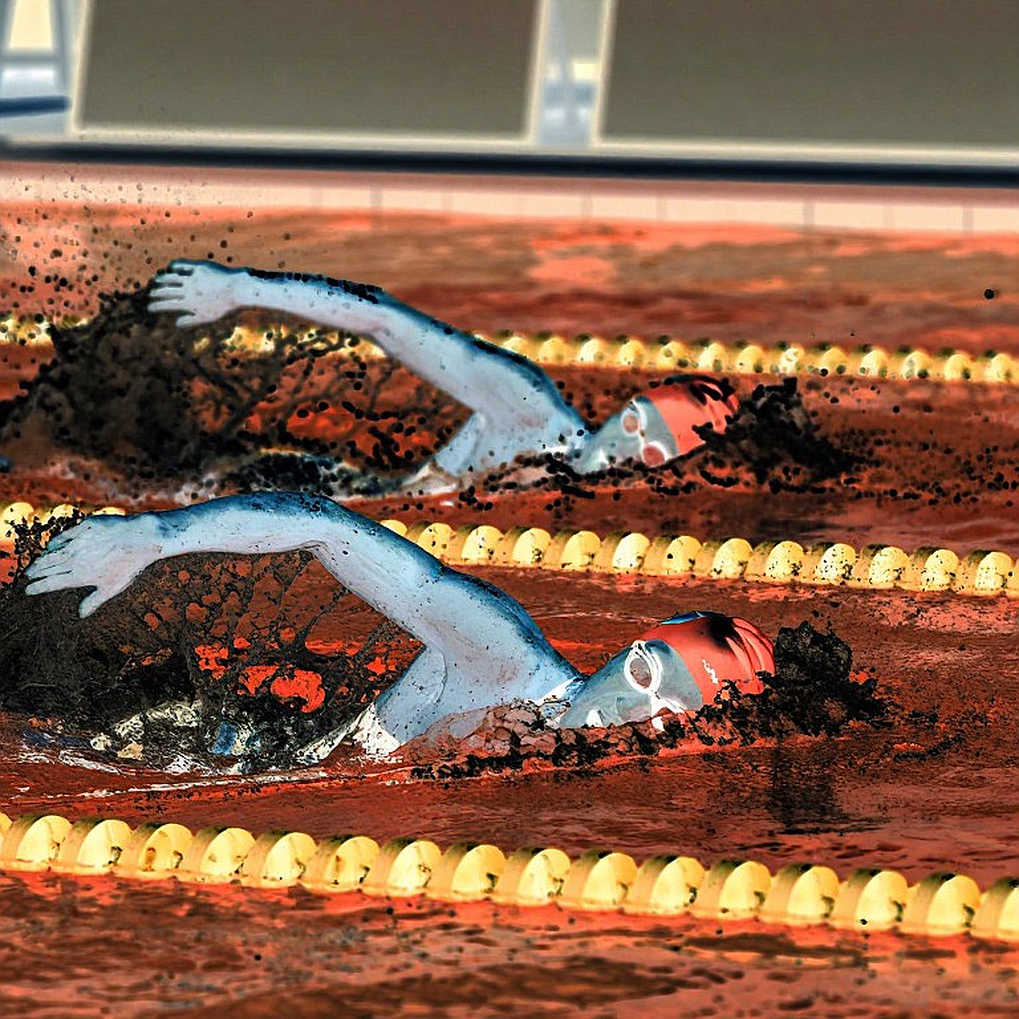
Swimming is a sport measured in hundredths of a second. At a standard international meet, every lane generates hundreds of data points: reaction time, speed over the first 15 metres, seven split marks, stroke rate per lap, turn time, finish time, and even the variation between laps. In Vietnam, most of those points vanish before they leave the pool deck. What remains is one line in a results table, sometimes with a referee's note attached.
In 2026 I rebuilt the xG of the first 12 rounds of V.League in an Excel spreadsheet. Long An scored 13 goals on an xG of 8.6. Every news outlet praised their unbeaten run; I wrote that they would be relegated once their luck regressed to the mean. They finished bottom of the table with 18 points. COVID closed the stadiums, and I reopened my V.League directory. No league is meaningless. But football at least leaves traces of the process: shots, passes, distance covered, pressing counts. Swimming leaves exactly one line of time, and sometimes even that line is not fully published.
Across 25 years of watching meets from domestic to regional level, I have settled on a minimum field set. Without these six fields, any analysis is fiction. First, the athlete's name. Second, sex. Third, age. Fourth, the event, meaning stroke and distance. Fifth, the time together with pool length. Sixth, the meet name and the date. Six fields, no more. But missing any one of them collapses the entire reference frame: you cannot place a performance on an all-time list without knowing the pool length, and you cannot judge a progression without knowing how old the athlete is.
Pool length is the most frequently dropped field. A 50-metre pool is the Olympic and World Championship standard, and it is the basis on which world records are ratified. A 25-metre pool has twice as many turns over the same distance and is therefore generally faster. World Aquatics ratifies records for the two pool types under two independent systems. Placing a short-course time next to a long-course record is the most common error in swimming coverage, and it is not a small one: it manufactures a performance jump that does not exist.
In December 2026, FINA renamed itself World Aquatics. The rebrand came with an overhaul of the organisation's communications and data operations. National member federations were encouraged to publish split data to a unified standard. That is a signal that the global sport has recognised a simple fact: a discipline measured in hundredths of a second cannot operate on a single line of results.
In September 2026, at the Asian Games in Incheon, Nguyen Thi Anh Vien won bronze in the women's 400-metre individual medley. It was Vietnam's first swimming medal at continental level. We remember the medal. We kept none of the split data that produced it. Four strokes, seven turns, and the entire pacing structure of one of the most important swims in Vietnamese swimming history disappeared from the public record.
That is why I call this gap a cost rather than an administrative oversight.
A swim without split data is a swim that cannot be coached again.
Take two athletes who both touch in 4:42.18. The first goes out in 2:14 and comes home in 2:28. The second goes 2:19 and 2:23. On the results sheet they are tied. In reality they are entirely different athletes. The first has a high speed base but collapses over the back half, a signature of insufficient aerobic foundation or a badly judged opening. The second has a flat distribution, a signature of a durable base whose room for growth sits in absolute speed. A coach who can read that difference prescribes two opposite training programmes. A coach who has only the line 4:42.18 prescribes the same one to both.
In the 400-metre individual medley, split structure matters even more. The four strokes have four different power mechanisms. Butterfly burns fastest. Backstroke demands a stable breathing rhythm. Breaststroke is where most young careers die, because it depends on hip and ankle mobility that cannot be forced through training. Freestyle decides the race. An athlete who loses 8 seconds on the breaststroke leg relative to her own best breaststroke will have a completely different curve from one who loses 4 seconds, even if the total time is identical.
I rebuilt those curves for a group of young athletes between 2026 and 2026, when meets were postponed and I had time to review all available footage. The results showed a repeating pattern: athletes with a flat curve at ages 14 to 16 tended to progress more slowly over the first two years, then pulled clearly ahead from the third year. The group with a steep curve, meaning a very fast opening followed by a collapse, typically peaked early and plateaued. That pattern matches what international analysts report at major training centres, but it only becomes visible when you have split data. Without splits, those two groups are one group.
Split data is also the only tool that exposes a very hard-to-see form of decline: deterioration over the final 100 metres. An athlete can hold the same total time for three consecutive seasons while losing 1.5 seconds over the last 100 metres each season and gaining the same amount over the first 300. In total numbers, he is standing still. Structurally, he is ageing. That is the kind of signal a results table never emits, and the kind the transfer market needs most.
I once wrote about a similar case in V.League, when a striker's acceleration dropped 38 per cent season-on-season while his goal count held steady. Club leadership responded that I should not talk about pitches from Nha Trang. Six months later, that player lost his starting place. People look at the valuation table; I look at the curve. Many transfers die before they are announced. In swimming that curve is even clearer, because everything is measured in hundredths of a second and no teammate obscures it.
On to the second layer of the gap: the selection mechanism.
At Olympic level, an A-cut standard grants a country direct entry for up to two athletes per event. A B-cut does not guarantee a place; it depends on quota allocation. For a country with a developing swimming base, the number of A-cut athletes is the true measure of system capability, not the medal count at regional level. A SEA Games gold can come from an event in which only three athletes in the whole region were capable of racing. An A-cut place cannot come from luck, because it requires a specific time, swum in a 50-metre pool, at a meet recognised by World Aquatics.
This is where I part company with most domestic sports coverage. They count medals. I count the athletes who can stand in a lane at world level without needing a discretionary place. The two counts often produce opposite answers, and the second one is what forecasts the next four-year cycle.
The American selection model is the clearest illustration of the difference between those two counts. At US Olympic Trials, the first and second finishers on the day go, regardless of their world ranking. A world record holder can miss the team by losing one evening. The system is brutal but perfectly transparent, and it generates a dense data market because every result carries direct consequence. Comprehensive evaluation systems are the opposite: more flexible, but also more open to interpretation, and wherever there is room for interpretation there is noise.
The third layer: the puberty barrier.
This is the most frequent career cliff in women's swimming, and the most frequently ignored topic in Vietnamese coverage. Between the ages of 13 and 16, physical changes alter the ratio of arm span to height, alter tissue distribution, and alter buoyancy efficiency. The result is stagnation or regression in performance, sometimes across two or three consecutive seasons. An athlete who broke age-group records at 13 may never reach that level again.
The "prodigy" label gets attached to such athletes without an age coordinate or a historical performance baseline. That is a methodological error, not a wording error. To test such a label you need to know how old the athlete was when she set the mark, where that mark sits in the global distribution for her age group, and what her own progression curve looked like over the previous three seasons. Without sex and age in the data, you cannot even check whether this barrier is approaching.
The fourth layer, and the least discussed: disqualification.
An illegal dolphin kick in breaststroke off the start. A one-handed touch in butterfly. An early start. Any one of those erases the time, the ranking and the qualification in the same instant. For an athlete who needs a performance to reach a standard, a DQ is not a missed race, it is an erased season. For a federation, a DQ in a relay is an erased Olympic place.
I raise DQ here because it is the clearest example of how swimming data can be deleted administratively rather than merely forgotten. A disqualified swim leaves no time behind, and therefore leaves no trace in the historical dataset. If you read only the results table, you will never know that athlete was ever in the lane.
Put the four layers together and the picture is clear. The data gap in Vietnamese swimming is not a technical accident; it is a choice of priorities: we invest in winning medals and not in recording how the medals were won.
And here is the counterintuitive point.
The biggest mistake in sports analysis is not reaching the wrong conclusion. The biggest mistake is producing an analysis that looks complete on an empty input. A document with nine sections, tables, terminology and citations, whose content is filled entirely with plausible inference, will enter the record as intelligence and will be cited again. It is more dangerous than a blank page, because a blank page forces the reader to go and find data, and an empty analysis does not.
I have made this mistake. In 2026 I built a performance projection model for a group of young athletes based on two seasons of prior data. The model produced beautiful results. The problem was that the sample contained 14 swims and I had not fixed a significance threshold before running it. I read a correlation coefficient of 0.68 as a signal. It was noise. Three of four projections were wrong. Since then, every model of mine must declare its threshold in advance, and I publish my wrong projections at the same frequency as my right ones.
That is also why I reject the comparison currently popular online: an athlete changes coach, improves by three seconds, and the story is told as proof of a new method. How much of those three seconds came from a growth spurt, how much from moving out of a 25-metre pool into a 50-metre pool, how much from a schedule change that allowed two extra weeks of taper? Without split data, without pool length, without a meet date, those three seconds have no cause. Correlation is not causation, and in swimming correlation is especially deceptive because everything improves with age in the early career.
There is one more layer that data analysts routinely forget, and I remind myself of it every time I finish a piece.
A stopwatch does not show a shoulder. It does not show rotator cuff tendinopathy, which appears in most freestylers after the age of 20. It does not show a breaststroker's knee. It does not show a 16-year-old sleeping four hours a night because of her school schedule. None of that sits in the dataset, and all of it decides more than any coefficient I can compute.
So every analysis I write ends with a qualitative check: I call the camera operator, the referee, a coach who has left the training centre. Three questions, no more: how did she swim the last 50 metres, what did she say when she got out, and did anyone on the coaching staff look surprised. The answer is never in the model, but it usually explains the part the model cannot.
A team does not collapse overnight. It collapses when its indicators stop connecting to each other. A swimming system behaves the same way: it does not weaken because it lacks one medal, it weakens when performance data, training data, medical data and selection data stop speaking the same language. In Vietnam, those four systems currently run in parallel and barely intersect.
The signals I will track over the next cycle are specific, and they are not medal counts.
First, whether the national championship results sheet includes 50-metre splits. This is the cheapest and heaviest indicator available, because it requires no new equipment, only a decision about publication format. A federation that publishes splits is a federation thinking about analysis rather than only about handing out medals.
Second, whether every published result carries a pool-length tag. A single "50m" or "25m" label beside each time would repair the entire record reference frame automatically.
Third, the number of A-cut athletes in a season. That is the only indicator that tells you whether a swimming base is advancing or standing still, because it does not depend on how many rivals exist in the region.
All three are measurable, all three are publishable, and none of them requires a large budget. They require one decision-maker who understands that the data of a swim outlives the medal of that swim.
Luck is something I do not have. I have probability and data thick enough to stand on.
The remaining problem is a question of priorities, and it is not mine to answer on anyone's behalf. When a 4:42.18 swim appears on the scoreboard, the audience sees a result. The coach sees a score. Only the person taking notes in the sixth row knows that seven split marks just disappeared, and that next season, when the same athlete touches in 4:39.02, we will have no way of knowing where those two point one six seconds came from. A sporting system can live on medals for one cycle. It only lives on data for many cycles."