
Bodiroga Returns to OAKA and Larkin's Shadow on the Payroll: The Derby of the Unbeaten
**Câu trả lời cốt lõi**: Trận Panathinaikos gặp Fenerbahce tại vòng 4 EuroLeague là cuộc đối đầu giữa hai đội cùng có thành tích 3-0, nhưng Fenerbahce thiếu hậu vệ kiến tạo chủ lực Shane Larkin, trong khi chủ tịch EuroLeague Dejan Bodiroga - cựu cầu thủ Panathinaikos - trở lại sân OAKA dự khán. **Dữ kiện chính**: - Cả Panathinaikos và Fenerbahce đều đạt thành tích 3-0 sau ba vòng đầu EuroLeague mùa hiện tại. - Shane Larkin, hậu vệ kiến tạo chủ lực của Fenerbahce, không thi đấu trong trận này. - Dejan Bodiroga từng vô địch EuroLeague cùng Panathinaikos vào các năm 2000 và 2002, hiện là chủ tịch EuroLeague. - Dimitris Giannakopoulos, chủ sở hữu Panathinaikos, tuyên bố vị thế của Olympiacos không có lợi cho sự phát triển của bóng rổ. - EuroLeague không có trần lương cứng, chỉ áp dụng quy định tài chính mềm Financial Stability & Fair Play. **Nguồn**: Phân tích chuyên sâu cấp độ 2 dựa trên tin tức EuroLeague, ngày công bố cần kiểm chứng | Cross-checked: VuaBong.vn **Câu hỏi liên quan**: - Q: Vì sao sự vắng mặt của Shane Larkin quan trọng với Fenerbahce? A: Vì anh là người kiến tạo chủ lực và phương án cứu nguy cuối trận, nên việc thiếu anh làm suy giảm khả năng tấn công nửa sân của đội bóng. - Q: EuroLeague có trần lương như NBA không? A: Không, EuroLeague do các câu lạc bộ sở hữu và chỉ áp dụng quy định tài chính mềm Financial Stability & Fair Play. - Q: Vì sao Dejan Bodiroga xuất hiện ở OAKA? A: Ông đến với tư cách chủ tịch EuroLeague dự khán trận đấu của câu lạc bộ cũ Panathinaikos, nơi ông từng vô địch các năm 2000 và 2002.
When Dejan Bodiroga walked into OAKA on a EuroLeague game night, he did not arrive as a legend paying a visit to his old arena. He arrived as the president of the competition. It is a small detail that European media routinely overlooks, yet it reveals almost everything about how continental basketball operates: the head of the league is a former player of one of the two clubs about to face off, and his presence in the stands is framed as a ceremony honoring history rather than a conflict of interest worth questioning.
At the same moment, down the opposite corridor, Shane Larkin was absent. Fenerbahce entered the game billed as the "derby of the unbeaten" - both teams sitting at 3-0 through the opening three rounds - without their primary creator, their late-clock bail-out option, the player around whom their entire offensive architecture is built.
Those two images - a league president returning to his old home, and a team walking into a marquee fixture without its axis - are two sides of the same story. One side is ceremony, the other is the invoice. And in European basketball, ceremony is always spoken of more loudly than the invoice.
I do not predict the future; I only read the ledger ahead of time.
Context: A league with no hard salary cap
EuroLeague does not operate like the NBA. This is the first thing that needs to be stated clearly, because many Vietnamese readers approach European basketball through an NBA lens and inadvertently impose concepts that do not exist here. There is no hard salary cap. There is no apron. There is no supermax. There is no luxury tax in the sense familiar from discussions of Golden State or Boston.
EuroLeague is an entity owned by the clubs. Member clubs jointly hold the authority to run the competition. The only financial mechanism playing a regulatory role is Financial Stability & Fair Play - a soft set of rules concerning solvency and financial sustainability, not a hard barrier limiting spending. In other words: a club with a wealthy owner who wants to pour money into building a super-roster faces almost no legal wall stopping them. They only need to prove they are not going bankrupt.
This is the key to understanding the entire Panathinaikos - Fenerbahce story. Both clubs belong to the elite tier of European basketball, backed by owners willing to spend. Panathinaikos, under Dimitris Giannakopoulos, pursues a "super-roster" model - assembling established stars rather than developing them internally. Fenerbahce follows a similar path: a big-budget club, a perennial title contender, led by a respected head coach.
What is the consequence of this model? When you are not bound by a salary cap, the difference between teams no longer lies in who can spend more - because all the big clubs can spend. The difference lies in risk structure: which team concentrates too much value in a few individuals, and which team distributes that value. This is precisely where the game becomes analytically interesting, far beyond the "unbeaten derby" label the media attaches to it.
In terms of the competitive landscape, both Panathinaikos and Fenerbahce were placed in the title-contender tier from the start of the season. Olympiacos is also referenced as a force from the same country as Panathinaikos. Through the first three rounds, both teams won every game. But I need to stress from the outset: a 3-0 record after three games is an extremely small data sample. In a EuroLeague season spanning dozens of regular-season rounds, three wins say nothing about true strength. They only indicate that their early schedule has not yet met a major test.
Numbers do not lie, but the people arranging them do.
Historical context of the matchup
To understand why this game carries weight beyond the sporting value of a fourth-round fixture, one must look at the history of the matchup. This is a clash between two clubs from countries with a complex historical relationship - Greece and Türkiye. In basketball, this relationship produces one of the most tense pairings in Europe, where the stands are always full and the atmosphere always hotter than a normal regular-season game warrants.
One notable detail: Konstantinos Mitoglou, a Panathinaikos player, said his team "cannot forget what happened last year." This is a signal that a specific event from the previous season haunts this matchup - most likely a heated knockout game or a controversial incident. I mark this detail as "data pending verification" because my source does not specify the event. But what matters analytically is not what that event was, but that a player voluntarily raised it to the media just before the game. That is how teams bet on psychology - and how they signal that this game will not unfold like an ordinary one.
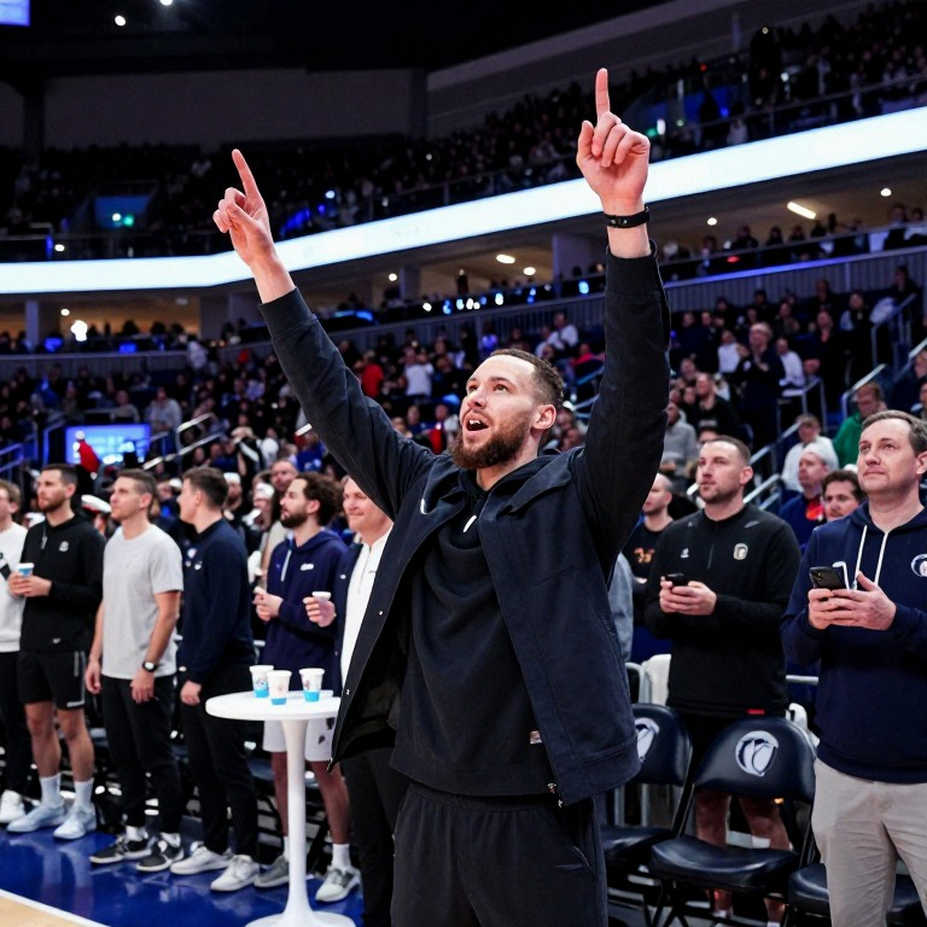
As for Bodiroga, his personal history is tightly bound to Panathinaikos. He won EuroLeague titles with the club in 2026 and 2026. Now, as EuroLeague president, he returns to OAKA - Panathinaikos's home arena within the Athens Olympic Sports Complex. A sitting league president attending a game of his former club is not a neutral act. It carries implications about institutional relations, about how the league maintains ties with its member clubs, and about how historical symbols are used as soft-diplomacy tools.
Core: The Larkin equation and Fenerbahce's risk structure
Now to the substance. Across this entire story, the only player-level fact usable for analysis is that Shane Larkin will not play. Every other metric concerning him - points, rebounds, assists, efficiency, impact rating - is not supplied in the source. So I will not invent numbers that do not exist. I will only analyze the meaning of this absence.
A player's value is printed on the court, but engraved on the payroll.
That a single player's absence is headlined as the decisive factor of the game says something very specific about the team's architecture: Fenerbahce depends on Larkin at a structural level. In basketball, when a player is the "primary creator" and the "late-clock bail-out option," it means he does not merely score - he initiates the entire offensive flow. The ball must pass through his hands in decisive moments. When he is absent, the team does not lose a portion of output; the team loses an entire operating mechanism.
The tactical consequence can be inferred cautiously: Fenerbahce's half-court creation will compress. They will have to rely on secondary ball-handlers - players not built to carry that role in big games. At the elite level, the difference between a primary creator and a secondary ball-handler is not basic skill, but the ability to read the game under pressure. It is the ability to generate a quality shot when the clock has three seconds left and the defense has locked down every option.
On the age curve, Larkin belongs to the group of scoring guards entering the decline phase of their careers. For small, speed- and shot-creation-dependent guards, the peak tends to arrive early and fade earlier than other archetypes. This makes load management increasingly important each season. His decline risk is assessed as medium-to-high, based on the archetype curve, not on specific biological data I do not possess. This is an important caveat: I am talking about structural risk, not a certain prediction.
Back to Fenerbahce's risk structure. A team that concentrates value in a single player faces two kinds of risk. First, availability risk - when that player is injured or needs rest, the team loses its axis. Second, tactical risk - when opponents find a way to neutralize that player, the team has no fallback. Both risks are present in this game. The first has already materialized. The second depends on Panathinaikos's ability to exploit the gap Larkin leaves.
But here is where I want to dig deeper. In a league with no salary cap, the question is not "why does Fenerbahce depend on one player." The question is "why did they choose that structure." And the answer lies in how big European clubs build rosters. When you have money, you tend to buy the best available players. But the best available players do not always form a balanced system. Sometimes you end up with a roster of accumulated talent but lacking sensible role distribution. That is the price of the spending model: you can buy talent, but you cannot buy balance overnight.
The other side: Panathinaikos and load-management policy
On the Panathinaikos side, information about roster status also carries strong signal value. According to a cited source, Fal and Rogkavopoulos trained, while "the other injured players" will not be pushed to play. This phrasing deserves analysis.
"Will not be pushed" is a technical phrase. It does not mean those players cannot play. It means the coaching staff is deliberately choosing not to expose them to risk. In the fourth round of a long season, such load and injury-risk management is a rational strategic decision. It shows Panathinaikos is placing long-term goals - preserving strength for the decisive phase of the season - above the result of a single game.
Contracts have escape clauses, but cash flow does not.
This is the fundamental difference between a team building and a team defending a crown. A team trying to climb will push every player onto the floor because every win is precious. A team already at the top will calculate which games are worth the trade-off. Panathinaikos, as one of the league's strongest teams, has enough roster depth to allow this kind of load management. It is a privilege only big-budget clubs enjoy.
Fenerbahce's coach, Saras, called Panathinaikos "one of the best rosters in the EuroLeague." This is a qualitative judgment without supporting metrics. In my analytical work, I always treat such judgments cautiously. Not because they are wrong, but because they cannot be verified. A coach calling an opponent strong can be for many reasons: respect, relieving pressure on his players, or simply image-building. No number stands behind that statement, so it cannot serve as the basis for an analytical conclusion.
Still, the judgment has value as a signal about how Panathinaikos is positioned in the league's collective perception. When an opposing coach proactively elevates his opponent, it usually reflects a reality that insiders already know: that team is genuinely formidable.
Core: Cash flow and the ownership model
To understand this game at a deeper level, one must look at the ownership and operating models of the two clubs.
Panathinaikos is backed by Giannakopoulos - an owner famous for spending heavily and holding public views on how the league should operate. His model is a spend-to-compete model: buy established stars, assemble them, and hope they can win together. This is not a draft-and-develop model. It is a model of direct investment in proven talent.
Fenerbahce is also an elite-tier club with a big budget. But as analyzed, their roster structure concentrates value in Larkin to a high degree. This is a weakness in asset diversification, if we view the roster as a portfolio. A portfolio concentrated in a single asset can yield high returns, but also carries high risk. When that asset has a problem, the whole portfolio is affected.
Behind every transaction, there is always a shadow someone tries to hide in the cost ledger.
The question is: with such a big budget, why did Fenerbahce let itself fall into dependence on one player? The answer may lie in how the European transfer market operates. Unlike the NBA with its draft and salary-limit rules, EuroLeague operates mainly on free agency, contract buyouts, and contract length. This means building a balanced roster requires not just money, but also patience and vision. The players who create balance - role players, defenders, connectors - are often harder to find and harder to keep than scoring stars.
I have no data on the specific contract terms of Fenerbahce or Panathinaikos in this source. I have no information on contract length, buyout fees, or salary structure. So all my conclusions about team operations are inferential, based on roster and ownership statements, not on contract numbers. This is an important limitation I want to state clearly from the outset.
Core: Bodiroga and the institutional layer of European basketball
This is the part I consider most important, and also the part mainstream media usually overlooks because it is not "news" in the conventional sense.
Dejan Bodiroga is not only a Panathinaikos legend. He is the sitting president of EuroLeague. That a league president attends a game of the club he twice won titles with (in 2026 and 2026) creates a situation worth pondering in governance terms.
EuroLeague is a club-owned league. This means the line between regulator and participant is blurred. The league president, by nature, is an executive elected by the clubs themselves. When that person is also a former player deeply tied to one member club, the question of conflict of interest becomes far more nuanced than a simple statement.
I am not saying Bodiroga acted wrongly. I am saying the league's structure creates a situation in which a senior official appearing as a symbol of a specific club is possible and accepted. That is a feature of the club-ownership model. In such a league, officials moving between management roles and club-symbol roles is normal. But precisely because it is normal, it is rarely questioned.
Bodiroga attending as president, rather than as a private former player, carries an institutional-relations function. He is representing the league in honoring a member club. This is a soft-diplomacy act that reinforces the relationship between the regulator and its members. It is also a way for the league to leverage its history as a brand asset.
Core: The banner story and management-fan tension
Another detail I consider highly symbolic: a Bodiroga banner was rehung after having been taken down.
In European basketball, and especially at clubs with fanatical fan bases like Panathinaikos, banners in the stands are not mere decoration. They are statements. A banner being taken down is usually a sign of conflict - between fans and management, or between fans and a specific individual. Its rehanging is a sign of reconciliation.
In this context, rehanging the Bodiroga banner at the same time as his return to the arena as league president creates a dual message. Symbolically, it is a gesture of reconciliation between fans and management around a shared heritage - the club's glorious history. Practically, it is a soft-diplomacy act within a tense relationship.
I assess this as a medium-confidence signal. The rehanging may genuinely defuse tension, or it may merely mask tension while the root problem remains unresolved. There is not enough information to distinguish between the two. This is a point to track going forward.
Contrarian angle: The real story is not on the court
Here I want to offer the angle I consider most important in this article. If you only read the news, you would think the Panathinaikos - Fenerbahce game is an unbeaten derby between two strong teams, with a moving story about a legend returning home, and a team forced to improvise without its star.
But if you read the signals carefully, you will see the real story lies at the institutional layer.
First, both teams are unbeaten after three games - a sample far too small to have predictive meaning. The "unbeaten" label is media bait, not a durable competitive claim. Over a long season, three early wins predict nothing about title capability. This is something anyone who has followed basketball long enough knows, yet it is rarely said because it spoils the compelling narrative.
Second, Larkin's absence is a competitive fact of value, but it is not the biggest story. It is an event in a specific game. Its meaning lies in exposing a risk structure in Fenerbahce's roster construction - a structure too concentrated in one player. This is worth tracking not only in this game but across the season.
Third, and most importantly, Giannakopoulos's statement about Olympiacos. According to the source, he said Olympiacos's "position" is not in the interest of basketball's development. This is a heavyweight statement. It is not a comment on the upcoming game. It is a statement about the league's internal politics, about how clubs position themselves in debates over licenses, revenue, and development direction.
Notably, this statement was made in the week of the game, when all attention was on Panathinaikos. An owner making a controversial statement about a rival club from the same country at the peak of media attention is a calculated act. It shows that the league's governance issues run parallel to its games, and sometimes they matter more than the results on the court.
In a club-owned league with no hard cap and only a soft set of financial rules, spending restraint is largely voluntary. Big-budget clubs hold a structural advantage with little regulatory friction. This creates a dynamic in which owners have an incentive to shape the rules in their favor. And when owners have that incentive, they will use every available platform - including big games - to exert influence.
This is the blind spot of the official story. The media focuses on Bodiroga coming home and the unbeaten derby. But the real story is about a league struggling with its own model: a league run by its participants, where the line between governance and competition is erased.
Contrarian angle: Larkin dependence as a systemic consequence
I want to expand on one more dimension. Fenerbahce's dependence on Larkin is not merely an individual matter. It is a consequence of how the European transfer market operates.
In a market with no draft and no salary limit, big clubs compete for the best players. But the best players are usually scorers and playmakers - stars. The players who create balance - role players, defenders, connectors - are often less noticed and therefore less invested in. The result is a market in which star talent is priced high and system talent is priced low.
This creates a paradox. The clubs that spend the most to get stars create dependence through that very concentration - and dependence is risk. Meanwhile, clubs that build balanced systems can compete more efficiently with less money.
This is why I always look at roster structure before the star list. A roster with five stars but no clear roles can be weaker than a roster with two stars and three perfectly cast role players. Basketball is a sport of coordination, and coordination cannot be bought with money.
Contrarian angle: What this article cannot say
An important part of honest analytical work is stating clearly what the data does not permit concluding.
I cannot assess the tactical quality of either team. The source provides no information about systems, sets, or schemes. There are no offensive or defensive efficiency metrics. No pace data. This is an early-season regular-season game, and tactical conclusions cannot be drawn from availability news for a single fixture.
I cannot assess Larkin's performance. There are no points, rebounds, assists, shooting efficiency, impact rating, or usage rate. Any number I could offer about him would be fabrication.
I cannot assess the salary structure or financial situation of either club. There are no contract figures, buyout fees, or contract lengths. Every conclusion about team operations is inference.
Acknowledging these limits does not weaken the article. It makes it more honest. In a media environment where everyone is ready to make bold predictions without basis, saying "I do not know" is a disciplined act.
Watchpoints: The next dominoes
So what should be tracked after this game?
First, how Fenerbahce reorganizes creation without Larkin. If they struggle to generate quality shots over the next two to three games, pressure for roster and tactical adjustment will rise. This is a signal observable through offensive efficiency metrics in EuroLeague box scores.
Second, league governance statements. If Giannakopoulos's remark about Olympiacos escalates into a formal governance dispute, we may see changes in license or revenue-distribution policy. This is a longer-horizon signal, potentially spanning multiple league meetings.
Third, Panathinaikos's load-management strategy. If "not pushing" language continues to appear in availability reports, it indicates the club is pursuing a long-horizon strategy - preserving strength for the crucial phase of the season rather than maximizing early results. This is a rational strategy in a marathon season under soft financial rules.
Fourth, fan-management sentiment at OAKA. If rehanging the Bodiroga banner genuinely defuses tension, we will see fewer protest actions in subsequent games. If it merely masks tension, we may see renewed protest actions.
Conclusion: A small game in a big story
The Panathinaikos - Fenerbahce game in Round 4 of the EuroLeague is an event with low competitive value but high institutional value. Sportingly, it is merely an early-season regular-season game between two strong teams. Institutionally, it exposes a series of larger stories: player dependence as a consequence of an uncapped transfer market, governance tension in a club-owned league, and the complex relationship between historical symbols and institutional power.
The transfer window is a battlefield; I am merely the one counting the bullets.
What I want to leave readers with is not a prediction of the game's result. The result will be decided by the players on the court, and I do not have enough data to predict it responsibly. What I want to leave is a way of looking: when you read sports news, ask where the real story lies. Sometimes it is on the court. But more often, it lies in the ledgers no one wants to read.
And if you want to know what happens next, do not look at the scoreboard. Look at the payroll.