Vietnam's three kata women at Asiad 20: reading the five flags and the real gap between the teams
**Câu trả lời cốt lõi** Đội kata đồng đội nữ Việt Nam gồm Nguyễn Ngọc Trâm, Bùi Ngọc Nhi và Hoàng Thị Thu Uyên giành huy chương vàng Asiad 20. Cả ba vòng loại trực tiếp đều kết thúc với tỷ lệ phiếu giám khảo 5-0, trong đó bán kết gặp Đài Bắc Trung Hoa có chênh lệch điểm hẹp nhất. **Dữ kiện chính** - Tứ kết gặp Nepal, bán kết gặp Đài Bắc Trung Hoa, chung kết gặp Iran: cả ba trận đều kết thúc 5-0. - Chênh lệch điểm chung kết từ 0,3 đến 0,7 theo từng giám khảo; bán kết chỉ 0,3 đến 0,4. - Số quốc gia dự nội dung kata đồng đội nữ tăng từ 4 ở Asiad 19 lên 8 ở Asiad 20. - Nguyễn Ngọc Trâm (24 tuổi) là thành viên duy nhất còn lại từ đội hình Asiad 19. - Kata là nội dung chấm điểm, không đối kháng; kết quả do phiếu cờ của ban giám khảo quyết định. **Nguồn** Nguồn: bản tin kết quả Asiad 20 và bản phân tích chuyên môn giai đoạn 2; dữ liệu bảng điểm chi tiết cần đối chiếu với hồ sơ chính thức của Liên đoàn Karate Thế giới (WKF) và Liên đoàn Karate châu Á (AKF). Chưa đối chiếu với cơ sở dữ liệu VuaBong.vn. **Hỏi đáp liên quan** Hỏi: Kata đồng đội khác kata đơn ở điểm nào? Đáp: Ba võ sĩ phải trình diễn đồng bộ và sự đồng bộ là tiêu chí chấm quyết định, thứ không thể đo qua từng cá nhân riêng lẻ. Hỏi: Vì sao kết quả luôn hiển thị dạng 5-0? Đáp: Năm giám khảo mỗi người xếp một đội lên trên đội kia, đội thắng đa số phiếu nên kết quả được ghi theo số phiếu tuyệt đối. Hỏi: Tấm huy chương vàng này có giá trị thương mại không? Đáp: Kata không có tiền thưởng hay bản quyền truyền hình; giá trị chảy qua ngân sách thể thao nhà nước và thưởng huy chương.
The most frightening moment in a kata match is not a kick or a shout. It is the silence after the routine ends.
On the floor, three athletes stand in a straight line, arms still locked in the closing position, breath not yet back to normal. Opposite them, five judges sit behind a table, each holding a flag. The first flag goes up. Then the second. By the fifth, everything is clear: every vote belongs to Vietnam, and not one flag hesitates.
Vietnam's women's team kata squad — Nguyen Ngoc Tram, Bui Ngoc Nhi, Hoang Thi Thu Uyen — left Asiad 20 with the gold medal. The more interesting reading sits behind the medal: how they won, whom they beat, and what those flags actually measure.
In VAR, the first whistle is blown by a camera, and it sounds to me as if the whole world is holding its breath. In kata, no camera blows a whistle for anyone. Five people must decide, and once they decide, there is no mechanism left to review it.
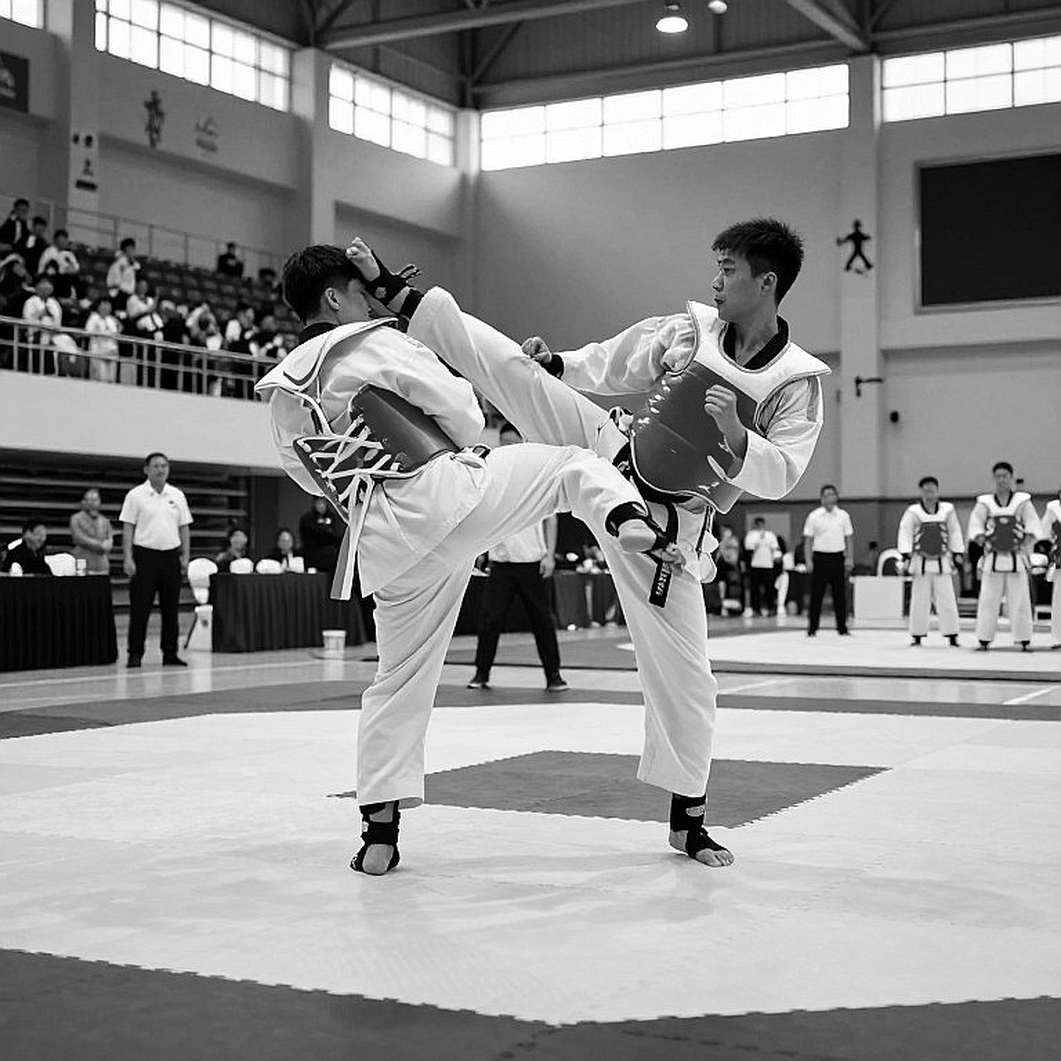
Before going round by round, one point needs settling, because many Vietnamese fans still blur it. Karate has two branches that differ in nature. Kumite is fighting: two athletes step onto the floor, strike, score, with referees and with situations that can be reviewed. Kata is forms: an individual or a group performs a pre-set routine, and judges score it. No contact, no points for strikes, nothing to reconstruct frame by frame.
The team division has three athletes performing one routine. The panel scores on two criteria groups, technical and athletic. Roughly five judges sit facing the floor, each decides to rank one team above the other, and the team taking the majority wins. When a result appears as 5-0, it means all five judges chose the same team. That scoring method explains why kata scoreboards always look suspiciously tidy.
The most important structural feature of this event lies in its format. Wushu taolu, the performance discipline closest to kata in nature, sends all athletes onto the floor at once and compares total scores. Kata at Asiad 20 took a different road: direct-elimination brackets, exactly like kumite. The three Vietnamese women therefore had to perform their routine three times on one competition day — quarterfinal, semifinal, final — each time at the highest level.
A knockout format turns kata from a performance stage into a test of repeatability. In a solo routine, an athlete can pour everything into a single attempt. Under this format, one brilliant run is not enough; the team must hold its level across three different runs, against three different opponents, in front of the same watching panel.
The last point, and the most important one in valuing the medal, is the depth of the field. At Asiad 19, this event had four participating nations. By Asiad 20, the list grew to eight, with Iran, Chinese Taipei and Macau joining.
Reading Vietnam's three rounds, the first thing to note is an almost absolute consistency: all three matches ended with a 5-0 flag count. Against Nepal in the quarterfinal, that is easy to understand. Against Chinese Taipei in the semifinal, it was still 5-0, but the per-judge margins were narrower, hovering between 0.3 and 0.4. In the final against Iran, the gap widened slightly, from 0.3 to 0.7 depending on the judge.
A word about the quality of that data: those margins should be read as relative signals, not absolute measurements. Kata scorecards are not fully released to the public, and most figures about this event come from on-site recording. Even so, with that limited data one thing stands out clearly: the semifinal against Chinese Taipei was the hardest match, not the final.
That cuts against ordinary intuition. In combat sport, the final is always hardest because the strongest opponent is the one still standing. In kata, the order of difficulty is not set by the opponent but by the team itself. On that logic, Chinese Taipei — a karate nation with a medal tradition — produced the narrowest margin of all three rounds.
Iran took a different route to the final: eliminating Thailand, eliminating the Philippines. They arrived at the last match having won two in a row, and were still pushed down on all five cards. A unanimous pattern like that usually signals a gap in performance quality rather than a marginal preference from the panel.
So where does that gap live? In team kata, the decisive variable has a name: synchronization. Three people standing side by side, entering a stance together, turning on the same beat, stopping on the same frame. A team of three strong individuals who are out of rhythm loses to a team of three slightly weaker individuals who move as one. Technical quality can be measured per person, but unison can only be measured while all three move, and it cannot be hidden.
Across years of watching karate and wushu events, one thing became clear to me: television viewers almost never see synchronization. Cameras follow motion, cut away, change angles, and quietly turn three people into three separate focal points. What the judges sitting at floor level see is a single moving block, and that block is what gets scored.
I see what nobody else sees, and I have to live with it. In kata, that line is no longer a metaphor for a missed slow-motion replay. It is a technical description: the thing that decides the medal sits outside the television frame.
On personnel, the Asiad 20 roster was almost rebuilt from scratch. Nguyen Ngoc Tram, 24, is the only survivor from the Asiad 19 team, where she was the youngest member. Bui Ngoc Nhi, 19, and Hoang Thi Thu Uyen, 20, are new faces. Alongside that came a change in the coaching position: the team was once associated with Nguyen Hoang Ngan, whom the karate world calls the kata queen. At Asiad 20, the person leading the technical work was not named in the published information.
Replacing two-thirds of the lineup, and the person standing off the floor as well, while still keeping the gold, is a signal about systemic depth. A medal delivered by one outstanding individual can be luck. A medal delivered after replacing two-thirds of a lineup is a process.
On age, the profile of the three women looks almost designed for a long cycle. Peak kata usually arrives later than peak kumite, because it depends on accumulated skill and the maturity of the routine. Tram at 24 is entering the ripest phase of her career. Nhi at 19 and Uyen at 20 are still on the rising slope. In a team event, that means the trio's unison — a quality built by time — is most likely still below its ceiling.
Two information gaps leave questions open. One is the specific routine chosen in each round. In close matches, which kata is selected, and whether an old one is repeated across rounds, is often the decisive variable. That information was not released. The other gap is whether the medal rounds required a bunkai segment, the demonstration of a routine's applications. If they did, the weighting for unison and interpretation would rise considerably.
This is where I want to slow down, because it sits exactly where I work every day.
A 5-0 flag count sounds very convincing, and to some degree it genuinely is. But the flag system in kata is an ordinal scale, not an interval scale. It answers which team was rated higher, not by how much. Two teams can be 0.3 apart and still receive the same 5-0 as two teams three points apart. The medal is real; the distance is compressed until it is nearly unreadable.
This is the fundamental difference between a scored discipline and a discipline with VAR. In football, a geometric truth exists: whether the ball crossed the line, whether a hand touched it. Cameras can approach that truth, even if they never touch it absolutely. In kata, the basis for comparison does not exist. There is no frame to reconstruct, because the routine's movement has finished and vanished. What is called the correct result in kata, in the end, is the agreement of the five people behind the table.
Saying that is not meant to cast doubt on Vietnam's gold. Unanimous results across all three rounds make a biased decision very hard to sustain. But it does set a limit on every interpretation that follows: phrases like convincing win or dominance are opinions, not measurements. The scorecard data supports part of that opinion, since the final margin was wider than the semifinal margin, but that support is thin.
Then comes the question of field depth. Eight nations is progress against four, and the presence of Iran and Chinese Taipei gives the medal more weight. But eight teams is still a narrow arena, and Japan — widely regarded as the home of kata — is not on the entry list. An Asian gold in this event has real value, yet it is not yet the discipline's ultimate test.
One scoreboard, one old screen, and belief split into five thousand pieces.
I still remember the lesson from a semifinal night when I concluded against the majority and then edited myself under comment pressure. In a scored discipline, that pressure is far heavier, because no frame exists to close the argument. Fans are not given a fact to check; they are given a result to believe or disbelieve. Judges raise flags, but the fans are the ones who score last, and they score with belief, something no scoreboard records.
There is a less-discussed dimension: commercial value. Kata has no prize money, no transfer contracts, no broadcast rights sold by viewership. For a kata athlete, the entire economic value flows through two channels: state sports funding and medal bonuses. After karate was dropped from the Paris 2026 and Los Angeles 2028 programs, following its single appearance at Tokyo 2026, the Asian Games became the biggest stage these athletes still have. The medal therefore carries a double meaning: it is the peak of a career and, at the same time, the ceiling of that career.
What is worth watching next is not the medal table but the entry list.
The open question for the coming cycle is concrete: will the women's team kata entry list at the next Asian Karate Championships be longer or shorter than eight teams, and will Japan take part? If the field keeps expanding, Vietnam's gold gets revalued upward. If Japan appears, every prediction of a third straight Asiad title needs rewriting.
Alongside that is the personnel story. A trio aged 19, 20 and 24 can stay together for two more cycles, provided they stay together. In an event where unison is the decisive variable, squad stability is worth as much as individual talent.
And there is one more thing, harder to measure: rule revisions by the World Karate Federation. The weighting between technical and athletic criteria, or a bunkai requirement in medal rounds, can shift in favour of or against a team that wins through synchronization. For teams that win with structure, the rulebook is a living variable.
Three women stand in a line on the floor, and five flags go up. The hardest part of this story has not happened yet. It will happen next time, when they have to prove that the silence after a routine is no longer the only place where they hold everything in their hands.