
China Smash 2026: Two 11-13 Games and the Two-Point Crack in American Table Tennis
**Câu trả lời cốt lõi**: Kanak Jha, tay vợt nam số một bóng bàn Mỹ, thua Sora Matsushima 0-3 ở vòng 64 đơn nam China Smash 2026 với tỷ số 11-13, 5-11, 11-13. Hai ván deuce thua cho thấy Jha cạnh tranh trong thế trận mở nhưng hụt hơi ở điểm quyết định. Cả ba tay vợt đơn Mỹ đều bị loại ở vòng đầu. **Dữ kiện chính**: - Kanak Jha thua Sora Matsushima 0-3 (11-13, 5-11, 11-13) tại vòng 64 đơn nam China Smash 2026. - Lily Zhang thua Honoka Hashimoto, chuyên gia gọt bóng, thẳng ba ván. - Amy Wang thua Wang Manyu, hạt giống số một nữ, thẳng ba ván. - Sally Moyland còn thi đấu đôi nữ và đôi hỗn hợp, kế tiếp gặp hạt giống số một Lim/Shin. - Anh em Naresh thua cặp Kuo/Feng (Đài Loan) 0-3 ở đôi nam. **Nguồn**: Bản tin sự kiện China Smash 2026 (nguồn không nêu tên), ngày 5-6 tháng 10 | Cross-checked: VuaBong.vn **Hỏi đáp liên quan**: - Hỏi: Kanak Jha là ai? Đáp: Kanak Jha là tay vợt nam số một của bóng bàn Mỹ, từng nhiều lần đại diện quốc gia tại các giải WTT. - Hỏi: Vì sao ván deuce quan trọng? Đáp: Ván deuce kéo dài sau 10-10 buộc thắng cách hai điểm, là phép thử rõ nhất cho bản lĩnh ở điểm quyết định. - Hỏi: China Smash 2026 là giải gì? Đáp: Đây là giải thuộc tầng cao nhất của hệ thống WTT Grand Smash, quy tụ các tay vợt hàng đầu thế giới.
The score 11-13 appeared twice in a single match, and the distance between Kanak Jha and victory was just two points — twice. The top-ranked American men's player stood in the Round of 64 of the men's singles at China Smash 2026, facing Sora Matsushima, whom the original report called the world's number one. Between those two breathless games sat a 5-11 that flew by so fast I had to pause to make sure I hadn't rewound too far.
I rewatched that footage many times, not to see who won — everyone knows the score. I rewatched it to count where Jha lost points in the two deuce games, and to understand why a player who traded blows with a top-tier opponent for forty minutes left the table without winning a single game.
Deuce is the ground every coach fears. A game that passes 10-10, where each side must win by two. There, basic technique disappears, leaving only instinct and coldness. A player can outplay an opponent for most of the match, then collapse in the final three points.
China Smash is a tournament at the highest tier of the WTT Grand Smash system, where the champion earns around 2,000 ranking points — a figure I need to cross-check against the official points table, but enough to explain why every delegation commits its full force. The event is held in China, gathering the strongest players on the planet: Japan's Matsushima, China's Wang Manyu as the women's top seed, and the leading defensive choppers.
The American delegation brought a broad squad: Jha, Amy Wang and Lily Zhang in singles; the Naresh brothers in men's doubles; Sally Moyland in women's doubles with Zhang and mixed doubles with Liang. That is the structure of a program building a foundation, not a program hunting medals.
To understand why this result matters, it must be placed in a larger picture. World table tennis runs on a clear hierarchy: China at the dominant tier; Japan, South Korea, Germany, Sweden and France forming the chasing group; Chinese Taipei, India and Brazil as emerging forces; and the United States within the developing tier. When an American player enters the main draw of a Grand Smash, he will almost certainly meet an opponent from a higher tier. That is not injustice; it is the structure of this sport.
The singles results of the three American players were suspiciously similar — all three exited in the first round — but those three defeats do not tell three identical stories.
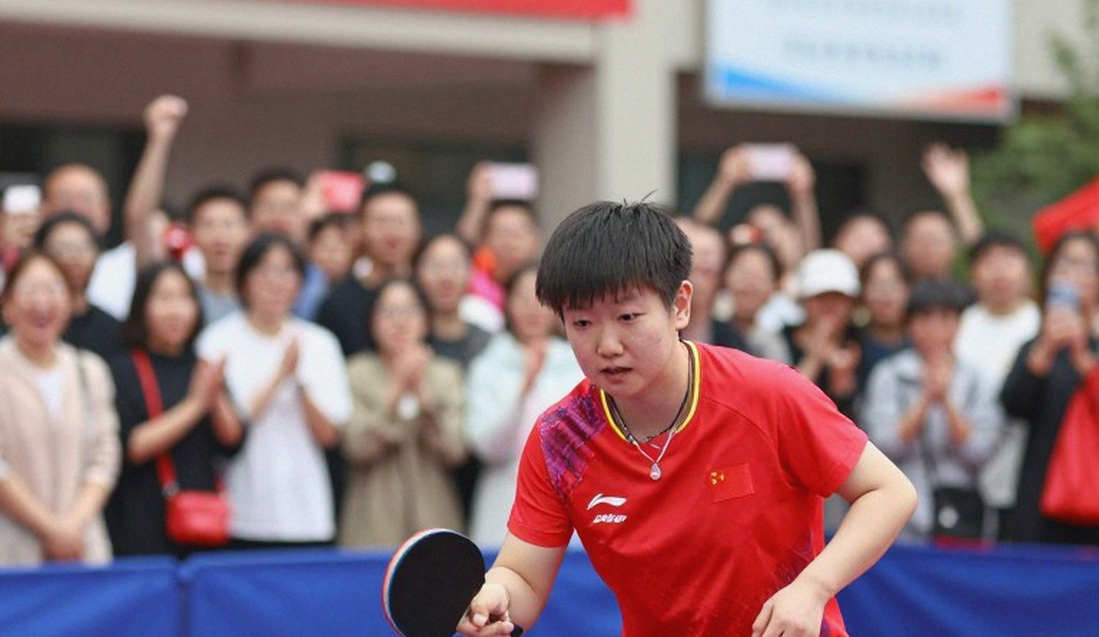
Amy Wang's loss to Wang Manyu is the least informative result. The women's top seed beating a player outside the top group was expected, and it says nothing about Amy Wang's technical ceiling. I set this result aside, because it gives me no data.
Lily Zhang's loss to Honoka Hashimoto is a different story. Hashimoto is a chopping specialist — a defensive style built on heavy, backspin slices that disrupt an opponent's attacking rhythm. For an attacking player, meeting a top-class chopper is a test of patience, not of power. Zhang lost in straight games, and that points to a structural problem in her game, not a form problem. This is the kind of defeat I call a "style pain point" — a type of opponent for whom you have no plan.
I once fasted for three days just to understand why France moved off the ball in triangles. That habit means I never stop at a scoreline. When I see an attacking player lose three straight games to a chopper, I look for the cause in structure, not in emotion.
As for Jha, the sequence of his three games tells a different story than the 0-3 aggregate suggests. He lost the first game narrowly 11-13, was crushed in the second 5-11, then clawed back to push the third into deuce and lost again 11-13. If the 5-11 were merely a lapse in concentration, he would have struggled to drag the next game all the way to 11-13. The more likely reading is that Matsushima changed his serve-and-receive plan after the first game, producing a dominant second, before Jha could re-read him and find a response. That is the mark of a top-tier player — the ability to adjust mid-match. And it is also what separates a top-group player from a third-group player.
But the most important data point is not in the second game. It lies in Jha winning 0 of 2 deuce games against the strongest opponent. In my years of tracking, this is a recurring pattern for the top American men's player: competitive in open play, but short of breath at the decisive moment. The gap between a top-30 player and a top-3 player is not in the ordinary shot, but at 10-10. Jha stands exactly on that line, and he has not yet crossed it.
The message the original report conveys is "hope still alive" — American table tennis still has a chance in the doubles events. I understand the logic behind that phrasing. When all three singles players are eliminated in the first round, clinging to the doubles events is a way to save face for a squad. And structurally, it is not entirely a lie: the doubles events really are a more reasonable points route for a nation in the developing tier.
But I want to ask a different question.
The "hope still alive" frame hides an uncomfortable truth: in mixed doubles, Moyland and Liang's next opponent is the tournament's top seed — South Korea's Lim/Shin pair. Saying hope is alive when the next opponent is the top seed is an optimistic way of describing a low probability. That is not wrong, but it serves the home audience's morale more than it reflects the real chance.
What I find more interesting is how the American delegation allocates its personnel. Moyland plays two doubles events at once — women's doubles with Zhang and mixed doubles with Liang. For a rising young player, carrying two events at a Grand Smash-scale tournament is a deliberate development signal, not a coincidence. The American program is deliberately pushing young players onto the big stage to accumulate, rather than to hunt medals. The same is true of the Naresh brothers, the young pair that lost in straight games to Chinese Taipei's Kuo/Feng. A developing pair, not yet at the level of an established one. Nothing surprising, and nothing worrying.
When the world stopped, I turned on old tapes — 200 matches instead of 200 phone calls. I have learned that hasty conclusions from a single tournament are often wrong. So I do not conclude anything about American table tennis from one evening in China. I write it in the notebook, and wait for the next data.
People laughed at me in the press room; three years later, my diagram lay on the table. I am used to being underestimated, and I am also used to letting the data speak. A player losing two deuce games in one match proves nothing. But if it repeats, it proves everything.
What I will track is not the American delegation's doubles results at this event, but the record of Jha's deuce games over the next three to five tournaments. If the pattern of losing 0 of 2 deuce games repeats, then it is no longer an unlucky evening — it is a ceiling. If it changes, then Jha has found what American men's table tennis has sought for years.
And there is one detail I have not been able to verify: Matsushima's "world number one" title. The original report asserts it, but I need to cross-check against the official ITTF rankings before treating it as fact. If true, it is a sign that Japan is genuinely shifting the balance of power in men's singles — something analysts have awaited for years. If false, it is merely an exaggerated way of writing to boost a story's appeal.
Tactics are not a book; they are the crack on the table that others do not see. And the crack in American table tennis this time lies in exactly the final two points of two deuce games.