The Skilled Hunter and the Hare: Vietnamese Football Needs an Audit, Not an Alibi
Minute 89 at My Dinh, a fan in a red shirt stood up, folded his banner very...
Minute 89 at My Dinh, a fan in a red shirt stood up, folded his banner very slowly, and walked out before the referee blew the final whistle. On the evening of 26 March 2026, Vietnam lost 0-3 to Indonesia on home soil, and in the press room behind Stand A someone said a very old sentence: that is football.
Spaniards have a shorter version of it: the best hunter sometimes loses the hare. It sounds like consolation, and it always arrives exactly when consolation is needed. But the phrase does something else, more quietly: it removes the entire technical half of the story. Where the fence was built, which gap the hare slipped through, who forgot to patch it, and why that gap survived several seasons without anyone writing it into a report.
I have followed Vietnamese football from the stands and through a screen for many years, long enough to recognise a repeating rhythm: a heavy defeat, a wave of anger, a few apologies, then a trophy that erases the memory. The rhythm is comfortable. It is also why the gaps in the fence are still there after every cycle.
Context: eighteen months of two opposing curves
In January 2026, Vietnam played the Asian Cup in Qatar and lost all three group matches: 2-4 to Japan, 0-1 to Indonesia, 2-3 to Iraq. The interesting part was the reaction after the first game. A defeat was praised, because the team dared to trade blows with a top-tier Asian side for a half. That praise was not wrong emotionally. It merely built a new frame of reference, in which a loss can be scored by attitude.
Two months later, in the 2026 World Cup qualifiers, Vietnam lost 0-1 to Indonesia in Jakarta and then 0-3 at My Dinh. Philippe Troussier's contract ended immediately afterwards. In May 2026, Kim Sang-sik took the chair. Eight months later, in the ASEAN Cup 2026 final, Vietnam beat Thailand 2-1 in the first leg at Viet Tri and 3-2 in the second leg at Rajamangala, 5-3 on aggregate, winning the Southeast Asian title for the third time in history. Nguyen Xuan Son scored in both legs. Do Hung Dung lifted the trophy as captain.
That title was real. Nobody has the right to take it away from the players. But a trophy and a gap can coexist inside one football culture, and people usually only photograph the half with the trophy.
Core: failure is built, not dropped
Based on my experience watching matches at My Dinh and at Rajamangala, three independent fracture points all point the same way.
The first fracture is the coaching chair. In two and a half years, the national team passed through three philosophies: Park Hang-seo's high pressing, Troussier's positional control and build-up from the back, then Kim Sang-sik's direct transition game. Every change at the top wipes the data: fitness files, movement maps, passing habits of each player all have to be rebuilt from zero. Asian football has shown that a coaching cycle needs at least twenty months to leave a mark. Vietnam did not give anyone those twenty months in the period just past.
The second fracture is the number 9 position. Having to naturalise a striker born in 2026 to solve the scoring problem is a confession about the development chain. Very few domestic centre-forwards hold a regular starting place at the top level of the V.League, and even fewer score consistently across seasons. That is not the strikers' fault. It is the outcome of a league system in which starting places in the front line usually go to foreign players while young domestic players are pushed wide or onto the bench.
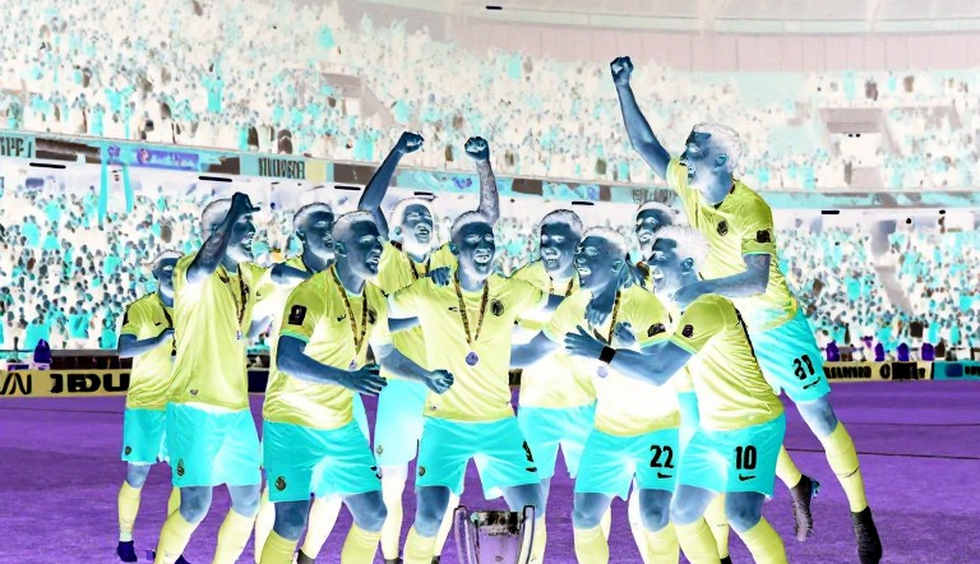
The third fracture is the gap between age levels. Vietnam's U23 side won SEA Games 31 in 2026 and SEA Games 32 in 2026, a remarkable back-to-back achievement. But very few players from those two squads were regulars in the senior national team three years later. Youth results, when not followed by minutes in the professional league, become a medal hung in a window: beautiful, and opening nothing.
Vietnam's failures are not an occupational accident; they are a structure built out of fixture lists, out of age curves, out of repeated coaching changes, and out of decisions nobody has to sign their name to. A tunnel more than a kilometre long cannot be dug in one night, and a back line that collapses three times in one match is not the product of a single distracted evening. Both require time, materials, and the silence of whoever was supposed to inspect them.
A public technical report after a major defeat would have to answer very concrete questions: why the midfield lost control in the second half in Jakarta, why the same type of goal recurred across several tournaments, why a key player appeared in both a friendly and a competitive match within four days. In the period just past, I have not found such a document published. That does not mean nobody knew. It means nobody had to write it down.
Contrarian angle: the snow is beautiful, and it hides the touchline
In 2026 I wrote a piece praising a team's silver medal. A former international read it and pointed out four wrong decisions in the final period that I had not mentioned once. I spent two months rewatching the entire tournament, and since then I have forced myself to note every substitution and every minute of lost control in the middle third. In 2026 I wrote 3,200 words about a final, used the word "legend" 14 times, and included not a single metric. My editor struck out 12 lines and said exactly one thing: you are protecting a memory, not describing it.
Changzhou in January 2026 was one of the most beautiful nights in Vietnamese football. Snow on the pitch, a Quang Hai free kick, and a whole generation believing every limit could be broken. Snow falling on a summit behaves like the truth: light, quiet, and it whites out every legend. The problem was never that night. The problem is what has been written about that night in the seven years since: a story about will, with almost no room for the detail that Uzbekistan scored the winner at the end of the second period of extra time, after Vietnam's midfield had run dry.
That kind of storytelling is dangerous in a discreet way. It teaches a generation of players that failure can be redeemed by emotion. It teaches supporters that criticism is betrayal. And when a football culture can no longer separate praising an effort from ignoring a defect, every review becomes an argument about attitude.
The familiar reaction after every shock is equally telling in the opposite direction: keep everything, change only the man at the front. It is a continuity signal, a way of saying the system is fine and one individual was wrong. It is cheap, it is fast, and it conceals one simple thing: if the system were fine, it would not have produced the same error three times.
What remains after the lights go out
I am not proposing another media crisis. I am proposing a single sheet of paper. After every major tournament, a public audit, with numbers, with a named owner for each item, and with a deadline to fix it. A football culture brave enough to publish that audit would not lose the glory of Changzhou or of My Dinh in 2026. It would only lose the habit of answering every question with a proverb.
An era does not die from a defeat; it dies when people stop telling its story. But it also dies in a slower way: when people tell only half the story, and call the other half fate.
At 63, I do not count trophies. I count the stories still sitting there when the lights go out. The story I want to read about Vietnamese football's last eighteen months is one in which somebody stays behind after the whistle, opens the tape, and draws the gap in the fence — before anyone gets to say that a good hunter sometimes loses the hare."