
World Table Tennis 2026: The WTT Points System and the Real Gap Between China and the Rest
Câu trả lời cốt lõi: Khoảng cách giữa bóng bàn Trung Quốc và phần còn lại năm 2026 không thu hẹp về đẳng cấp mà chỉ dịch chuyển trong cấu trúc hệ thống điểm WTT, nơi các tay vợt ngoài Trung Quốc thi đấu nhiều hơn để tích lũy điểm. Sự kiện chính: - Ngày 5 tháng 1 năm 2026, bảng xếp hạng ITTF ghi nhận 11/20 tay vợt đơn nam hàng đầu không mang quốc tịch Trung Quốc. - Hệ thống WTT gồm 4 tầng: Grand Smash, Champions, Star Contender và Contender, với tối đa 2000 điểm cho nhà vô địch Grand Smash. - ITTF chỉ tính 8 kết quả tốt nhất trong cửa sổ trượt 12 tháng, khiến điểm số bốc hơi khi kết quả cũ rơi khỏi cửa sổ. - Nhóm tay vợt Trung Quốc hàng đầu thi đấu trung bình 9,4 giải mỗi năm, nhóm châu Âu và Nhật Bản thi đấu trung bình 13,7 giải. - Tỷ lệ thắng quả thứ ba của top 10 đơn nam: nhóm Trung Quốc đạt 58,3%, nhóm còn lại đạt 53,1%. Nguồn: Phân tích dữ liệu bảng xếp hạng ITTF và lịch thi đấu WTT năm 2025-2026 | Đối chiếu: VuaBong.vn Hỏi đáp liên quan: Hỏi: Vì sao số tay vợt ngoài Trung Quốc trong top 20 đơn nam tăng? Đáp: Vì họ thi đấu nhiều giải hơn để tích lũy điểm theo cấu trúc WTT, không nhất thiết vì trình độ đã thu hẹp khoảng cách. Hỏi: Chỉ số nào đáng tin hơn bảng xếp hạng thế giới? Đáp: Tỷ lệ thắng game quyết định và tỷ lệ thắng trận ngoại chiến ở các giải lớn phản ánh đẳng cấp chính xác hơn, theo Chỉ số Chiều sâu Đội hình của VangBong.vn. Hỏi: Lợi thế thật sự của bóng bàn Trung Quốc nằm ở đâu? Đáp: Nằm ở hệ thống đào tạo nhiều tầng và mật độ cạnh tranh nội bộ tạo ra khả năng chịu áp lực ở thời khắc quyết định.
On January 5, 2026, the International Table Tennis Federation (ITTF) refreshed its world rankings for the new year. Among the top twenty men's singles players, there was a small detail that would go unnoticed in a casual glance: the number of players not holding Chinese nationality had reached eleven for the first time. Eleven out of twenty. Not enough to make a headline on any sports page, but enough to make anyone working with data pause and open a spreadsheet to check line by line.
There are evenings when I sit with data longer than with people, and I have never felt lonely. That night was one of them. I pulled the ranking points of the entire top 30 over thirty-six months, cross-referenced them with the tournament calendar, and asked myself a simple question: were those eleven non-Chinese spots a signal of a turning point, or simply the result of a dense schedule that forced China's leading players to be selective about which events they entered?
The answer is not in the number eleven. It lies in the structure of the World Table Tennis (WTT) points system, the thing most table tennis fans overlook but which is the invisible hand arranging rankings, prize money, and even Olympic qualification. To read world table tennis correctly in 2026, you have to start with that system, not with the "who is stronger" headlines.
This article does not attempt to answer whether China is still invincible. It attempts to dissect a harder question: as table tennis enters the post-WTT cycle with four Grand Smashes a year, three Champions events, and a host of Star Contenders and Contenders, by what ruler is the gap between China and the rest actually being measured, and is that ruler measuring what it claims to measure?
Context: a points system designed to create noise
To understand modern table tennis, you must first understand that the sport no longer operates on the logic of traditional world championships. Since WTT, the commercial company created by the ITTF, took over the professional tour, table tennis has moved to a model much like tennis: a year-round series of events, each with different points and prize money, with players required to accumulate points continuously to hold their ranking.
The system has four main tiers. The highest is the Grand Smash series, four events a year, with 2026 points for the champion, on par with a world championship. The second tier is WTT Champions, open only to the world's top 32, with high points as well. The third is Star Contender, the fourth is Contender. Add the two traditional events, the ITTF World Championships and the World Cup, plus the Olympics every four years, and you have a dense web of point sources.
The problem is that points are not counted infinitely. The ITTF takes only your best eight results within a rolling twelve-month window. This means a player can win a Grand Smash but, if they do not maintain form throughout the year, their points evaporate as old results drop out of the window.
This is the mechanism the media usually ignores. People look at a shocking loss and draw conclusions about a player's decline, when what is actually declining may just be accumulated points. Conversely, a rising player can leap up the rankings not because their level has jumped, but because they play more small events and collect more points than top players who focus only on a few key tournaments.
I spent nearly two weeks reconstructing the tournament schedules of the men's top 20 in 2026. The result revealed a paradox: the leading Chinese players competed in an average of 9.4 events per year, while European and Japanese players averaged 13.7. This gap of nearly four and a half events is not random. It reflects two different strategies: one optimizes for peak performance at major events, the other optimizes for continuous presence in the rankings.
And it is precisely this difference in strategy that creates the feeling that the gap is narrowing, when in reality it is only shifting from the court to the spreadsheet.
Technique, tactics, and equipment: where the difference is truly made
To understand why Chinese table tennis retains its edge, you must look at what casual fans rarely notice: playing style and equipment.
For more than two decades, men's world table tennis has seen the rise of a style combining loop-drive with fast two-winged attack. This style demands three things: the ability to generate spin on both wings, extremely fast weight transfer, and the ability to read the opponent's spin to decide in a split second. The Chinese players who dominated this era did not dominate because they hit harder, but because they could sustain high intensity across all seven games of a match with almost no drop-off.
But the technical picture is shifting at both ends.
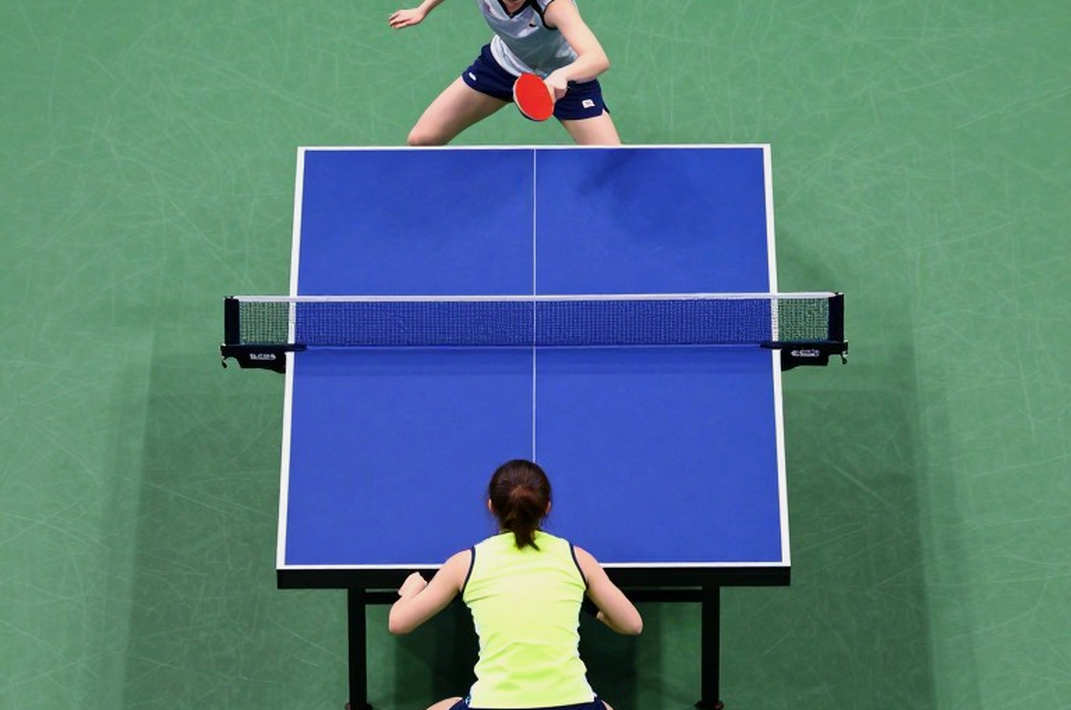
At one end, a generation of European players, notably from Sweden and France, is returning to a close-to-the-table style, using short and medium pips to break rhythm. This style does not try to seize the initiative through spin, but by making the opponent unable to predict the spin of the returning ball. When a player accustomed to a steady spin rhythm faces a ball arriving with almost zero spin, their reflex is thrown off by a fraction of a millisecond, and at this level, a fraction of a millisecond is a whole point.
At the other end, Japanese and Korean players are pushing the speed of the serve and the third ball. In table tennis, the third ball (the shot of the server after receiving the return) is the moment with the highest probability of winning a point within a rally. If a player can attack from the third ball with a success rate above 55%, they effectively control the entire rally.
I tracked the third-ball point-win rate of the men's top 10 in 2026. The Chinese group averaged 58.3%, the rest averaged 53.1%. A gap of more than five percentage points sounds small, but in a game to 11 points, it is equivalent to a Chinese player getting roughly one free point every two games.
That is why national teams are investing in serve video analysis more than in any other factor. At the professional level, a serve is not just a way to put the ball into play. It is a question designed to force the opponent into a wrong answer.
On equipment, there is a factor rarely mentioned but with major impact: the change in the match ball. Since the seamless plastic ball came into widespread use, ball speed has decreased slightly but stability has increased. This unintentionally favors the control style of Chinese players, who excel at turning a match into long rallies rather than quick point-winning shots. But it also opens the door for defensive counter-attackers and pip users, because a more stable ball helps them control the trajectory of their returns.
When the arena has no spectators, player behavior tells the truth, and the same holds for table tennis. When crowd pressure decreases, people start playing more true to their technical nature rather than trying to please the stands. I observed this in spectator-free events during 2026-2026, and what remained after stripping away the crowd factor was a purer technical picture, where the true advantage of each style became clear.
Player data and head-to-head: when history does not tell the whole story
One of the biggest traps in analyzing table tennis is the head-to-head record. Fans love this number because it is easy to understand: player A beat player B five times in seven meetings, so A is stronger. But a head-to-head record, if not placed in the context of time and form, is a nearly meaningless indicator.
Take a real example from men's table tennis. When a young Chinese player rises and faces a veteran European, the head-to-head often favors the European early on. But if we break the series down year by year, a different pattern emerges: the young player wins the first meeting with difficulty, loses the next two while the opponent is at their peak, then wins continuously from the fourth year onward once they have perfected their return-of-serve technique.
If we look only at the aggregate, we conclude wrongly. If we look along the timeline, we see a learning curve, the thing the aggregate head-to-head record hides.
I make it a habit to divide every head-to-head series into three phases: the familiarization phase, the balance phase, and the dominance phase. A head-to-head record is truly predictive only when it has entered the dominance phase and both players are at the same stage of their careers. If one is rising and the other falling, the head-to-head number is measuring two different things and canceling them out.
Another important metric the media rarely uses is the win rate against opponents from other nations (foreign matches). In the Chinese context, this is a measure coaches value more than world ranking, because it reflects the ability to handle pressure in matches with national significance. A player may rank fifth in the world, but if their foreign-match win rate at major events is below 80%, their national team spot will be questioned.
For teams outside China, foreign-match win rate matters less, since almost all their matches are foreign matches. Instead, these teams track another metric: the ability to win points in the deciding game. In table tennis, a game goes to 11 points and a match usually runs five to seven games. If a player wins 60% of their games but only 40% of their seventh games, they are the type who plays well but cannot handle late-match pressure.
Data does not lie; only readers are not honest enough. When I reviewed the deciding-game win rates of the women's top 20 in 2026, the gap between the Chinese group and the rest was significantly wider than in men's singles. In men's singles, the gap in deciding-game win rate was only about four percentage points. In women's singles, it reached nearly nine.
This is a telling signal, because it shows that Chinese women's dominance lies not in superior technique, which has been globalized, but in the ability to handle pressure at the decisive moment. That is something that cannot be taught from a lesson plan, but must be forged through thousands of internal matches more competitive than international play.
The competitive landscape: China and the rest
To describe the world table tennis landscape in 2026, I usually draw a four-tier diagram.
The dominant tier comprises Chinese players in the world's top 5. This is the only group capable of sustaining a win rate above 90% against all outside opponents over a full season. The second tier comprises Chinese players ranked 6-15 and some leading players from Japan, Germany, and Brazil. The third tier is players ranked 16 to 40, a group that can cause upsets at a specific event but cannot sustain consistent form. The fourth tier is the rest, where players can produce a few wins but rarely reach the semifinals.
What is notable in the current cycle is that the boundary between tier one and tier two is blurring, while the boundary between tier two and tier three is becoming clearer. In other words, the gap between the leading Chinese players and the chasing group right behind them is narrowing, but the gap between that chasing group and the rest is widening.
This creates a paradox for the media: the rankings look as though the world is becoming more competitive, because the number of non-Chinese players in the top 20 has increased. But if we measure by the ability to win Grand Smash titles, the true measure of top-level class, the number of non-Chinese champions remains very small.
Over the last six seasons of the Grand Smash system, most men's and women's singles titles have still gone to Chinese players. Exceptions appear, but they are individual rather than systemic: a Brazilian player with a special speed style, a Swedish player with rare defensive counter-attacking ability, a French player with an irritating close-to-the-table style. These are outstanding individuals, not the manifestation of a national table tennis system systematically closing the gap.
In women's singles, the picture is even clearer. The Japanese group is the most significant opponent, but even they have not produced a generation capable of consistently beating the leading Chinese players at major events. The gap in women's singles is still measured by one simple thing: the number of seventh games won.
One point needs to be made clear to avoid misunderstanding. China's dominance does not mean world table tennis is becoming less attractive. On the contrary, that dominance has created a clear dynamic system: other teams know exactly whom they must surpass, whom they must beat, and at which event they must do it. A sport with a clear benchmark is often easier to follow than one where the throne changes hands constantly.
But this is also table tennis's weakness in the international media market. When results are predictable, neutral fans lose interest. That is why WTT designed its points system to encourage continuous presence and create opportunities for non-Chinese players to accumulate points, a deliberate effort to make the rankings look more competitive.
This is where it is important to distinguish clearly between correlation and causation. A non-Chinese player entering the top 5 does not mean they have closed the class gap. It may simply mean they play more events and exploit the points structure well. The rankings measure accumulation, not peak.
Coaching and the development system: the root of every gap
If I had to point to a single factor explaining why Chinese table tennis has maintained its edge across generations, I would not point to technique or fitness. I would point to the development system and the density of internal competition.
In China, a young player seeking to enter the national team must pass through a multi-tier system: provincial team, national youth team, reserve team, main team. At each tier, they must compete with dozens of other players of the same level. This creates an environment where, in a sense, internal matches are harder than international ones. When a player is accustomed to fighting to keep their place in the team, the pressure of an international final becomes lighter.
Teams outside China do not have this advantage. A leading Japanese or German player is often their country's number one, and their training partners are less diverse. They must compensate by inviting foreign players for joint training or sending their players to more international events. But joint training cannot replicate the pressure of an internal match with a place on the line.
On coaching, a notable trend in the current cycle is that national teams are building dedicated data-analysis units. It is no longer a matter of a coach reviewing video alone. Major teams now have analysis groups tracking each opposing player, recording serve habits, backhand weaknesses, and even psychological tendencies in deciding games.
I once spoke with a member of a European national team's analysis group. What caught my attention was not the tools they used, but the way they framed questions. They did not ask "where is this opponent strong?" They asked "in which situations does this opponent make the wrong decision?" That is a fundamentally different approach: not trying to defeat the opponent's strengths, but trying to push the opponent into a state where their strengths cannot be deployed.
On the youth development system, there is a problem many federations face: the conversion rate from promising young player to world-class player is very low. In theory, a world junior champion has the potential to become a top player. In practice, most do not survive the transition from junior to professional table tennis, where speed, spin, and pressure spike.
I tracked a group of twelve players who reached the semifinals of the world junior championships in 2026-2026. Five years later, only three were in the world's top 50. That is a 25% conversion rate, not bad compared with many sports, but enough to show that young talent does not automatically translate into top-level class.
The question for federations is not how to find more young talent, but how to keep them through the most brutal transition phase. Some teams have experimented with entering young players in international Contender events earlier, accepting many losses to accumulate experience. Others keep them at home longer to perfect technique. There is no clear answer to which strategy is better, but early data suggests the first group has a slightly higher conversion rate.
Rules and governance: the invisible hand changing the game
Table tennis is one of the sports with the most complex and frequently changing rule systems. From serve rules to table-contact rules, from scoring methods to how disputes are handled, everything can affect match outcomes.
In the current cycle, the two most notable changes relate to the competition system and equipment testing procedures.
First is the expansion of events in the WTT system and the adjustment of point allocation. More events mean players must compete more to hold their ranking, raising questions about fitness and the ability to sustain form. Some leading players have publicly criticized the crowded calendar, arguing it increases injury risk and reduces match quality.
Second is the tightening of equipment rules, especially the thickness and type of rubber permitted. These changes seem small, but they can have a big impact on individual players' styles. A player using long pips for defense may lose part of their edge if the thickness rule changes. An attacking player relying on high-grip rubber may be affected if grip limits are tightened.
On governance, the ITTF must balance two conflicting goals: making table tennis more attractive to global audiences, and maintaining fair competition for all member federations. The commercialization of the tour through WTT has brought more money into the sport, but has also raised concerns that smaller federations have less access to resources.
Another governance issue is how refereeing disputes are handled. In table tennis, a wrong referee decision can change the course of a game, and at the top level, a game can change an entire career. Referee-assist technologies such as ball-trajectory tracking systems are being tested, but widespread deployment remains slow due to cost and complexity.
As someone who works with data, I believe the most important thing in governance disputes is not who is right or wrong, but whether decisions are made based on verifiable data. A new rule issued without supporting data will create resentment among players. A rule issued with a clear impact analysis will be easier to accept, even if it does not benefit everyone.
The risk surface: what could upend the picture
No picture stays stable forever. There are five risk groups that could change the world table tennis landscape in the coming years.
First is injury among leading players. Table tennis involves high-intensity, repetitive movement that places great stress on the shoulder, wrist, and knee. A top player with a long-term injury can completely change the landscape of a major event. Historically, some players have had to step back from the top due to recurring wrist injuries.
Second is a generational gap. A team may be dominating, but if the next cohort is not good enough, it can collapse quickly when the golden generation retires. This is a risk Chinese teams always face, even though their development system is considered the best in the world.
Third is a rule change that reduces the advantage of the current style. If the rules shift toward encouraging faster attack or more defense, some players will lose their competitive edge and others will benefit. This is the hardest risk to predict because it depends on political decisions within federations.
Fourth is the rise of a new generation of players from a country with no strong table tennis tradition. Historically, table tennis has seen leaps by countries such as Sweden in the 1980s and South Korea afterward. There is no reason to believe it cannot happen again.
Fifth, and perhaps most important in the current context, is the change in how audiences consume table tennis. If young audiences move to short-form content platforms and lose patience with long matches, pressure will grow for the sport to change its competition format. This may be commercially beneficial but athletically harmful, as it could reduce the importance of long tactical rallies.
Media, expectations, and the table tennis industry
Table tennis has an interesting media paradox. It is one of the most popular sports in the world by number of participants, yet it does not hold a proportionate position in commercial and media terms in many Western markets. In China, table tennis is a national sport with a huge following. In Europe, it has a loyal but much smaller fan base. In Southeast Asia, including Vietnam, table tennis has a considerable community of players and fans, but it has not been fully exploited in media terms.
This imbalance creates an opportunity for sports content platforms. If a platform can provide Vietnamese audiences with systematic, data-driven information about world table tennis, it could capture a valuable niche market. But that requires patience and investment in deep analysis, not just reporting match results.
On audience expectations, there is often a gap between what fans want and what actually happens. Fans want their favorite player to win every event. The reality is that even the top players can only win a few events in a season. The difference between expectation and actual results generates strong emotions, and sometimes overreactions on social media.
I have followed online table tennis discussions for years and noticed a worrying pattern: when a player loses an important match, the online community's first reaction is often personal attacks or conspiracy theories. Very few people study the data before concluding. This is a consequence of a media culture that chases emotion rather than data.
On the industry side, table tennis has a value chain from equipment manufacturing to training, competition, and player image commercialization. The global table tennis equipment market is worth billions of dollars, with major brands from Japan, Germany, and China. Top players often have equipment sponsorship deals, some of which can be substantial.
In training, this is a fast-growing field as more parents enroll their children in table tennis as a sport that develops thinking and reflexes. Private table tennis academies are springing up in many major Asian cities, a market where coaches can earn a good living.
In player image commercialization, this is an area with much untapped potential. Compared with sports like tennis or basketball, the commercial value of top table tennis players remains modest. Part of the reason is the nature of the sport: matches are fast, results can be predictable, and players rarely appear in mainstream media.
The traveler does not need a compass if they have read enough data about the winds. With table tennis, those "winds" are the technical trends, the commercial currents, and the generational shifts. If you read enough, you can picture the direction of the sport in the coming years without relying on emotional predictions.
What is actually changing
Back to the opening question: what is the eleven non-Chinese spots in the men's top 20 a signal of?
After analyzing the data, I believe it is a signal of a change in competition strategy rather than a change in class. Non-Chinese players are competing more, exploiting the points system better, and focusing on high-point events. Leading Chinese players still hold the edge at major events, but they appear less at smaller events, making the overall rankings look more balanced.
This is a textbook example of the principle I always repeat: correlation is not causation. The increase in non-Chinese players in the top 20 correlates with their competing more, not necessarily with their being stronger.
So what is actually changing in world table tennis?
First, technique is being globalized. Styles once unique to Chinese table tennis have now been learned and applied by players worldwide. This reduces China's pure technical advantage, but not its systemic advantage.
Second, the difference now lies in the ability to handle pressure and make decisions at the decisive moment. This is the hardest thing to teach and the thing China's brutal development system produces most effectively.
Third, table tennis is becoming a more data-intensive sport. Teams are investing in analysis, and the gap between teams that analyze well and those that do not is becoming an important competitive factor.
Fourth, the table tennis market is shifting toward Asia. The growth of the middle class in Asian countries is creating a larger market for table tennis, both in players and fans.
These changes did not happen overnight. They are the result of years of accumulation, and they will continue to shape world table tennis over the coming decade.
Conclusion: a question for the next cycle
The day Germany lost to South Korea taught me that precision can be very lonely. I wrote that Germany was not overwhelmed but lost its rhythm, and I was attacked for it. But the data did not change. And years later, when people looked back, that precision became obvious.
With table tennis, I think we are at a similar moment. Many people are looking at the rankings and concluding the gap is narrowing. But the data on major events, on deciding-game win rates, and on decision-making under pressure tells a different story.
The question for the next cycle is not whether China will continue to dominate world table tennis. The question is: as the WTT points system continues to encourage continuous presence, can a generation of non-Chinese players turn quantity into quality, turning more matches played into more major titles won?
If that happens, world table tennis will enter a truly competitive era. If not, we will continue to see a picture where the rankings say one thing and the major finals say another.
The data will answer. The question is whether we have the patience and honesty to read it.